Transformer Calculator & Configurator
Use MGM Transformers’ Phase Calculator tool to the left to enter any two of kVA, volts or amps. The tool will solve for the remaining third input.
Or use the Configurator below to build a complete quote from phase, voltage, taps, temperature rise, K-factor and enclosure information.
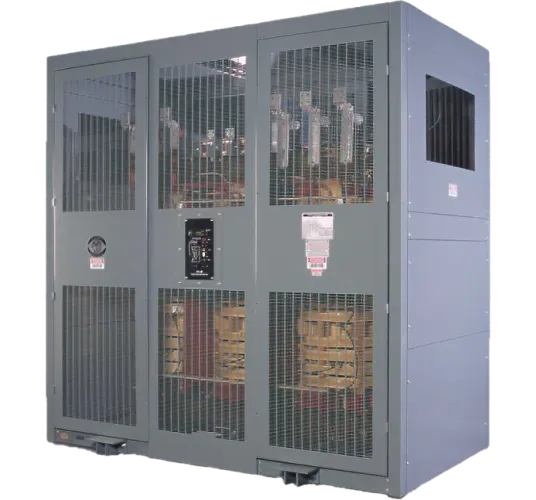
Configurator
1. CATALOG CODE
2. Get a Quote
Enter your catalog code or create a code using the drop-down options below to display the configuration of your unit.
Your CATALOG CODE
Unit Configuration
Phase Calculator
Insert any two values to calculate the third:
Transformer Sizing Formulas (kVA, Amps & Voltage)
The calculator uses the standard relationships between power (kVA), voltage (V), and full-load current (amps):
Single-Phase
- kVA = (V × A) ÷ 1000
- Amps = (kVA × 1000) ÷ V
Three-Phase
- kVA = (V × A × 1.732) ÷ 1000
- Amps = (kVA × 1000) ÷ (V × 1.732)
Turns ratio = primary voltage ÷ secondary voltage = N₁/N₂. The same equations give primary and secondary full-load amps (FLA).
Why √3 (1.732)? In a balanced three-phase system the three voltages are 120° apart, and the line-to-line voltage equals √3 × the line-to-neutral voltage. That is why three-phase power uses the 1.732 factor: use √3 with line-to-line voltage, or 3 with line-to-neutral voltage.
Worked example. A 75 kVA three-phase unit at 480 V: Amps = 75 × 1000 ÷ (480 × 1.732) = 90.2 A. At 208 V the same 75 kVA draws 208 A.
kVA to Amps, Amps to kVA & kW Conversions
Convert between apparent power (kVA), current (amps), and real power (kW). kVA and amps do not need power factor; kW and kVA do.
- kVA → Amps (1φ): A = kVA × 1000 ÷ V
- kVA → Amps (3φ): A = kVA × 1000 ÷ (1.732 × V)
- Amps → kVA (1φ): kVA = A × V ÷ 1000
- Amps → kVA (3φ): kVA = 1.732 × A × V ÷ 1000
- kW → kVA: kVA = kW ÷ PF. kVA → kW: kW = kVA × PF.
Examples. 200 A at 240 V three-phase = 83 kVA. 70 kVA at 480 V three-phase = 84 A. 80 kW at 0.8 power factor = 100 kVA.
Power factor (PF) is real power ÷ apparent power. Transformers are rated in kVA, not kW, so sizing on kW alone leaves you undersized. Typical PF by load:
| Application | Typical PF |
|---|---|
| Data centers (AI/HPC) | 0.85-0.95 |
| Industrial / motor loads | 0.70-0.90 |
| Hospitals | 0.80-0.90 |
| Resistive / heating | ~1.0 |
How to Size a Transformer
- Identify the load. Note the load voltage and full-load current (amps), or the connected kW and power factor.
- Calculate required kVA with the formula above for your phase type.
- Add headroom. Size so the unit runs near 80% of capacity: divide the minimum kVA by 0.8 (about +25%) for continuous loading and future growth.
- Round up to a standard kVA rating (see the table below).
- Account for the environment. Choose temperature rise, K-factor (for non-linear / harmonic loads), and enclosure (NEMA) rating for the install.
Rule of thumb & example. A 400 A, 240 V three-phase service needs about 400 × 240 × 1.732 ÷ 1000 = 166 kVA minimum, so with headroom, a 225 kVA standard unit. Always confirm final sizing with a licensed engineer and the NEC.
Standard Transformer kVA Ratings
Transformers are built to standard kVA sizes. Round your calculated load up to the next size:
- Single-phase: 1, 1.5, 3, 5, 7.5, 10, 15, 25, 37.5, 50, 75, 100, 167, 250, 333, 500 kVA
- Three-phase: 3, 6, 9, 15, 30, 45, 75, 112.5, 150, 225, 300, 500, 750, 1000, 1500, 2000, 2500 kVA
MGM Transformers builds general-purpose, dry-type, K-factor, and custom units across this range, many in stock.
Full-Load Amps (FLA) Charts
Three-phase full-load current (A = kVA × 1000 ÷ (V × 1.732)):
| kVA | 208V | 240V | 480V | 600V |
|---|---|---|---|---|
| 15 | 41.6 | 36.1 | 18.0 | 14.4 |
| 30 | 83.3 | 72.2 | 36.1 | 28.9 |
| 45 | 124.9 | 108.3 | 54.1 | 43.3 |
| 75 | 208.2 | 180.4 | 90.2 | 72.2 |
| 112.5 | 312.3 | 270.6 | 135.3 | 108.3 |
| 150 | 416.4 | 360.8 | 180.4 | 144.3 |
| 225 | 624.5 | 541.3 | 270.6 | 216.5 |
| 300 | 832.7 | 721.7 | 360.8 | 288.7 |
| 500 | 1387.9 | 1202.8 | 601.4 | 481.1 |
| 750 | 2081.8 | 1804.2 | 902.1 | 721.7 |
| 1000 | 2775.7 | 2405.6 | 1202.8 | 962.3 |
Single-phase full-load current (A = kVA × 1000 ÷ V):
| kVA | 120V | 240V | 480V |
|---|---|---|---|
| 5 | 41.7 | 20.8 | 10.4 |
| 15 | 125.0 | 62.5 | 31.2 |
| 25 | 208.3 | 104.2 | 52.1 |
| 50 | 416.7 | 208.3 | 104.2 |
| 75 | 625.0 | 312.5 | 156.2 |
| 100 | 833.3 | 416.7 | 208.3 |
Need the full 600V-class and medium-voltage charts? Download our reference documents.
Transformer Overcurrent Protection (NEC 450.3)
For transformers rated 1000 V or less, NEC Table 450.3(B) sets the maximum overcurrent device rating as a percentage of the transformer’s rated full-load current. Simplified guidance:
| Protection method | Primary | Secondary |
|---|---|---|
| Primary only (primary FLA ≥ 9 A) | ≤ 125% | n/a |
| Primary & secondary (secondary FLA ≥ 9 A) | ≤ 250% | ≤ 125% |
| Primary only (primary FLA 2 to 9 A) | ≤ 167% | n/a |
| Primary only (primary FLA < 2 A) | ≤ 300% | n/a |
Where 125% does not match a standard device size, the next higher standard rating is permitted. This is a simplified summary of NEC 450.3(B); always size protection to the current NEC edition and your AHJ.
Single-Phase vs Three-Phase Transformers
Use the single-phase calculator mode for residential, light-commercial, and control-power loads; use the three-phase calculator mode for most industrial and commercial distribution. At the same kVA and voltage, a three-phase unit draws lower current per line because of the √3 factor, which is why three-phase distribution is more efficient for larger loads.
Step-Up & Step-Down Calculations
A step-up transformer raises voltage (e.g., 240 V to 480 V); a step-down transformer lowers it (e.g., 480 V to 208 V).
Fault Current & Impedance (%Z)
A transformer’s nameplate impedance (%Z) sets the available short-circuit current on the secondary. Approximate available fault current = secondary full-load amps ÷ (%Z ÷ 100). Example: a 500 kVA, 480 V unit (FLA 601 A) at 5% impedance can deliver roughly 601 ÷ 0.05 = 12,000 A, so size your secondary breakers and conductors for that available fault current.
Transformer Terms & Definitions
- kVA: apparent power (kilovolt-amperes); the transformer’s capacity rating.
- kW vs kVAR vs kVA: real power (kW), reactive power (kVAR), and apparent power (kVA); kVA = √(kW² + kVAR²).
- Power factor (PF): kW ÷ kVA; how much current actually does work.
- Full-load amps (FLA): current drawn at the rated kVA.
- Impedance (%Z): nameplate value that sets available secondary fault current.
- Taps: winding connections that fine-tune output voltage (e.g., ±2.5%).
- Temperature rise: allowable winding temperature above ambient (e.g., 115°C, 150°C).
- K-factor: rating for handling harmonic (non-linear) loads such as data-center and VFD loads.
More terms in our transformer glossary.
Convert load voltage and current to kVA (kVA = V × A × 1.732 ÷ 1000 for three-phase), then round up to the next standard rating with about 25% headroom.
Size for roughly 80% loading: divide your calculated minimum kVA by 0.8 and round up to a standard size.
About 208 A at 208 V and 90 A at 480 V (three-phase). Use the calculator for any voltage.
About 69 A at 208 V and 30 A at 480 V (three-phase).
About 83 kVA at 240 V three-phase, or 48 kVA at 240 V single-phase.
A 400 A, 240 V three-phase load is about 166 kVA minimum, with headroom, a 225 kVA standard unit.
kVA is apparent power; kW is real power. kW = kVA × power factor. Transformers are rated in kVA.
Yes: toggle the phase before entering values and the formula switches automatically.
It returns standard engineering values for planning. Confirm final sizing and overcurrent protection with a licensed electrical engineer and the NEC.