Modernizing Power: How Transformer Design Is Reinventing Grid Reliability
The Art of Reliability
Electricity feels invisible, until it isn’t there.
Every second, it moves through copper, steel, and air, pulsing quietly across the country. The steady hum of the grid is the sound of reliability itself.
Transformers are the unsung instruments of this harmony. They balance energy, absorb stress, and keep power flowing safely between where it’s generated and where it’s needed. But just like a symphony, even a small fault can throw the entire system off-beat.
As America modernizes its grid to meet new demands (from renewables to electrified transport), transformer design is being reimagined from the inside out.
The Grid’s Hidden Weak Point
America’s grid was built for a different world, one powered by steady demand and one-way flow. For most of the 20th century, energy flowed predictably, one way, from power plants to consumers.
Today, it moves in every direction. Rooftop solar panels feed excess power back into the grid.. Electric-vehicle charging stations create sudden spikes in demand overnight. Wind farms ramp up and down with the weather. Regional grids are having to adapt to absorb wind and solar surges that rise and fall by the hour.
Behind the scenes, much of this infrastructure is showing its age. Additionally, this two-way energy flow is stressing equipment that was never designed for it.
According to the U.S. Department of Energy’s National Transmission Needs Study (2023), much of the U.S. transmission network is operating well beyond its intended lifespan. Nearly three-quarters of new development in the past decade has been driven by reliability upgrades, clear evidence of a grid working harder than it was ever designed to.
Transformers sit at the heart of this strain. As they age. efficiency declines, cores run hotter, and more energy escapes as heat. Across thousands of units, these small losses compound, increasing both operating costs and vulnerability during peak demand.
At the same time, climate pressures are rising. DOE data shows that weather-related power outages have increased nearly 70% since 2000, underscoring how resilience now matters as much as capacity.
Furthermore, according to the U.S. Energy Information Administration’s Annual Energy Outlook 2024, total electricity demand is expected to grow by another 14% by 2030, driven by electrification and data-center expansion.
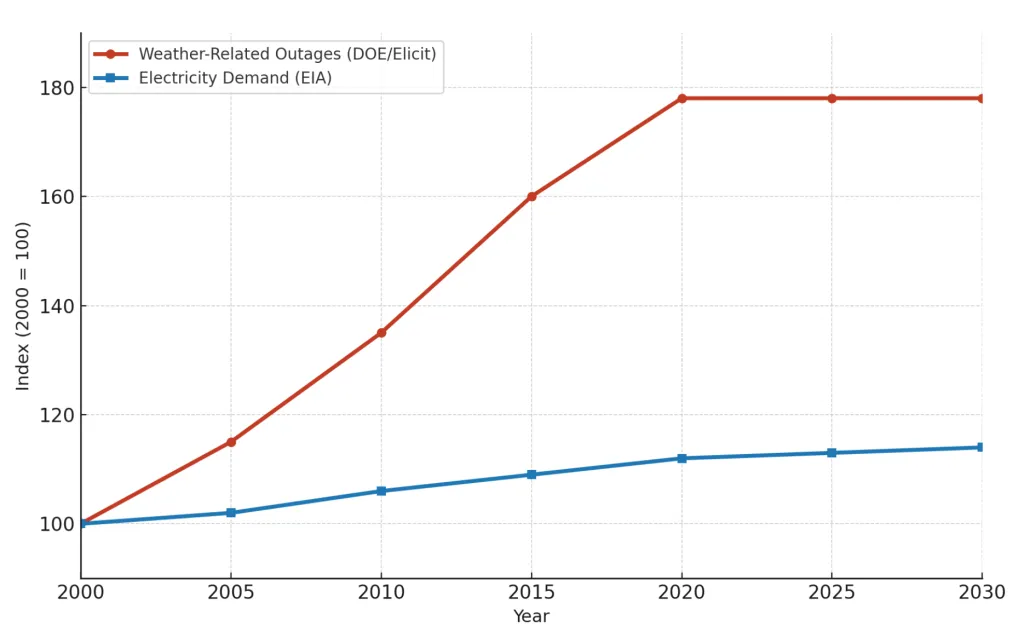
Figure 1. Rising Grid Stress: Weather-Related Outages vs. Electricity Demand (2000–2030)
Sources: U.S. Department of Energy, Electric Disturbance Events (OE-417) Annual Summaries (2023); U.S. Energy Information Administration, Annual Energy Outlook 2024; Elicit Research Report, Weather Impacts on U.S. Electricity Demand (2024). Values shown for illustrative purposes.
Designing Reliability from the Inside Out
Reliability begins with the materials that make up a transformer. Every layer, from the core steel to the insulation paper, determines how well it will withstand stress.
MGM Transformers engineers focus on three core design pillars:
- Custom Engineering: Transformers are tailored to environmental realities — from coastal humidity to desert heat.
- High-Efficiency Cores: Amorphous or grain-oriented steel reduces magnetic loss, improving performance and longevity.
- Precision Manufacturing: Laser cutting, digital winding, and automated testing ensure exact tolerances in every component.
Each of these choices improves heat management, voltage control, and mechanical stability — small refinements that, together, define the transformer’s lifespan and dependability.
Innovation in Manufacturing
As transformer designs evolve, so does the way they are built. The craft that once relied on manual precision has merged with digital intelligence, blending hands-on expertise with advanced modeling and automation.
Digital tools like CAD modeling and finite element analysis (FEA) allow engineers to simulate stress points and optimize magnetic flux before production even begins.
This digital-first approach reduces waste, shortens production time, and ensures every unit meets the highest efficiency and acoustic standards.
MGM Transformers’ investment in lean manufacturing also supports sustainability, reducing scrap steel, minimizing rework, and optimizing energy use during fabrication.
Built for the Real World
In practice, design precision means transformers that perform reliably in the field — not just on paper.
For example, a distribution transformer installed near the Gulf Coast must withstand salt corrosion and high humidity, while one in the Nevada desert must tolerate extreme heat and thermal expansion. These differences drive true customization. Each unit is engineered for its specific environment, not built from a generic mold.
Environmental conditions such as salt fog, thermal cycling, and dust ingress are major factors in transformer longevity. That’s why manufacturers like MGM Transformers design in accordance with IEEE Standard C57.12.00, which defines performance and environmental conditions for safe, reliable operation across diverse climates.
Beyond structural resilience, modern designs also allow for optional remote monitoring. MGM Transformers offers integration features that let utilities track voltage, temperature, and load by providing early insight before issues escalate.
This kind of awareness supports predictive reliability, reducing maintenance costs, improving uptime, and keeping communities powered even under stress.
The Craft Behind Reliability
Behind every transformer is craftsmanship. The way coils are wound, the precision of lamination stacks, and the symmetry of magnetic fields all determine whether a unit hums efficiently for 30 years or fails after ten.
At MGM Transformers, quality control isn’t a checkpoint; it’s a mindset. Each transformer is inspected through multiple stages under ISO 9001-certified processes, with digital records maintained for traceability and long-term performance benchmarking.
That culture of precision is what allows utilities to trust the unseen — to know that the hum they hear on a hot summer day is power working exactly as it should.
The Future of Transformer Design
Transformer design is evolving with technology and purpose.
Federal grid-resilience programs are encouraging designs that merge reliability with sustainability, the same philosophy driving MGM Transformers’ next-generation models.
As new materials emerge (from amorphous-core steel to bio-based insulating fluids), the industry is finding ways to make transformers quieter, cleaner, and longer-lasting.
Add-on communication options like Modbus Ethernet connections give utilities remote monitoring capabilities, providing performance data on voltage, load, and temperature without requiring full smart-grid integration.
Each of these innovations moves the industry toward a future defined both by efficiency and awareness, a future where transformers do more than deliver power; they help protect it.
As the grid evolves, the story of reliability expands beyond the equipment itself.
It’s no longer just about how transformers are built. It’s about what they make possible.
Every efficiency gain, every monitoring upgrade, and every smarter coil winding connects to a larger purpose: helping the nation move toward cleaner, more distributed energy.
Renewables don’t just need places to generate power; they need systems that can manage it. And this is where transformer design becomes more than an engineering discipline. It becomes the quiet enabler of the renewable energy transition.
Transformers and the Renewable Energy Transition
The path to cleaner energy depends on more than solar panels and wind turbines; it depends on what connects them.
Every renewable installation, from a coastal wind farm to a desert solar array, relies on transformers to balance output, manage fluctuating loads, and stabilize voltage before the power ever reaches the grid.
MGM Transformers’ engineering focus aligns with this mission. Its medium-voltage and distribution transformers are built for performance and adaptability, featuring high-efficiency cores, weather-resistant coatings, and integrated monitoring options that give operators real-time visibility into operating conditions (from temperature to load balance) in real time.
In renewable applications, this awareness is essential. When the wind drops or clouds roll in, transformers must react instantly to maintain steady voltage and protect downstream systems from disruption.
According to the U.S. Energy Information Administration’s Electric Power Monthly (March 2025), solar energy set a new record in early 2025.
- Combined utility-scale and small-scale solar generation grew 33.7% over the previous year and supplied nearly 6.8% of all U.S. electricity during the first quarter, surpassing hydropower output for the first time.
- In March alone, solar accounted for 9.1% of national generation, underscoring how fast renewable integration is reshaping grid demand and flexibility requirements.
By supporting this shift with durable, efficient, and communication-ready transformers, MGM Transformers helps renewable energy systems deliver on what they promise: reliable, sustainable, power built to last.
To see how these design principles apply across renewable, industrial, and data center applications, learn more about MGM Transformers’ transformer solutions across the industries we serve.
Conclusion
The future of the grid depends on what we build today and how thoughtfully we build it.
Every transformer leaving MGM’s facilities carries the work of engineers, designers, and craftspeople committed to one principle: reliability through design.
Because when the lights stay steady through the next storm, or the next surge, that quiet confidence isn’t a coincidence; it’s engineering made visible through trust.
Over the last 3 decades MGM Transformers has installed over 1Trillion KVA transformers with greater than 99.99% reliability. Learn more about how MGM Transformers supports America’s evolving energy future, delivering reliable, efficient, and locally-made transformer solutions built for tomorrow’s grid.
Contact MGM Transformers to discuss your next project or request a custom quote.
MGM Transformers is part of Forgent Power. Forgent Power brings together over 100 years of experience across its family of brands, including MGM Transformers, VanTran, PwrQ, and States, providing high-performance electrical distribution solutions, accelerating industries to keep critical infrastructure running. For more information, visit www.mgmtransformers.com and www.forgentpower.com.


Recent Posts
Understanding the Different Types of Transformers: A Complete Guide for Industrial and Commercial Applications
Transformer Reliability: How to Maximize Performance & Minimize Downtime
The U.S. Electricity Grid: How Transformers Power a Smarter, More Resilient Future
Inside the Bull Rush Program: Advancing American Transformer Production and Delivery